
Beyond information: what should health literacy actually change?
Health literacy should do more than deliver information. It should strengthen people’s ability to understand, navigate, decide and act, while making healthcare easier to understand and use.

Health systems are good at measuring what they deliver.
We can count consultations, workshops, factsheets, website visits and participants.
What is harder, and often more important, is measuring what people can actually understand and do afterwards.
That distinction matters because providing health information and building health literacy are not the same thing.
Someone can leave a consultation carrying printed information and still be unsure what their medicine is for. They may not know which side effects matter, what to do if something changes, where to find trustworthy information or how to raise a concern with their health professional.
The information has been provided.
But has anything changed in their ability to manage their health?
Health literacy should build capability
Health literacy is sometimes approached primarily as an information problem: if people do not know something, give them more information.
Information matters. But information on its own is rarely enough.
The purpose of health literacy should be to increase people’s ability to understand, navigate, decide and act.
When it comes to medicines, that means looking beyond whether someone has been given information.
Do they understand why they are taking their medicines? Can they make sense of the instructions on a pharmacy label? Do they know where to find reliable information? Do they feel confident asking questions when something is unclear? Can they maintain an accurate medicines list? Do they know when a problem requires advice or further care?
These are different outcomes from simply asking whether information was supplied.
And they matter because much of healthcare happens outside the consultation room.
Someone living with diabetes, cardiovascular disease, chronic pain or several long-term conditions makes countless small decisions between appointments. They decide whether something is important enough to ask about, whether a symptom might be related to a medicine, whether information found online can be trusted and whether they have understood the instructions they were given.
Health literacy influences people’s ability to make those decisions and participate confidently in their own care.
At MedicinesEd, this distinction is central to how we think about medicines education. Knowing about a medicine is not necessarily the same as understanding it. Education should help people do something with what they learn, not simply receive more information.
Health literacy is also a system responsibility
There is another risk in the way health literacy is sometimes discussed.
We can make it sound like a deficit belonging entirely to the individual.
If someone does not understand their care, it can be tempting to conclude that the person has “low health literacy”.
Sometimes the more useful question is:
How easy have we made healthcare to understand and use?
The Australian Commission on Safety and Quality in Health Care describes health literacy as having two interconnected parts: individual health literacy and the health literacy environment. That environment includes the services, systems, information, policies and interactions that affect how easily people can access, understand and use health information and healthcare.
That distinction is important because healthcare is complicated.
People may move between general practice, pharmacy, hospitals, specialists, allied health, community services and other supports.
Healthcare may be organised into separate services, providers and funding streams, but people experience the consequences of how well those parts connect. When communication, handover or navigation is poor, the work of making sense of the system often falls back on the person, their family and other carers.
Each organisation may understand its own part of the health system very well. The person moving between those services still has to make sense of the whole.
Health literacy therefore cannot be treated solely as a characteristic of the consumer.
Health services also have a responsibility to communicate clearly, reduce avoidable complexity and make it easier for people, their families and carers to navigate care and participate in decisions.
Health literacy is therefore also a service-design, workforce and system-capability issue.
Confidence matters as well as knowledge
Knowledge is relatively easy to recognise.
Confidence is less visible, but it matters.
Someone may know that they are allowed to ask questions about their medicines and still feel uncomfortable doing so.
They may worry about appearing difficult. They may assume the clinician is too busy. They may not know which questions are reasonable to ask. Or previous experiences may have left them reluctant to speak up.
Good health education therefore needs to do more than increase knowledge. It should also help people develop the confidence and practical skills to participate.
We have seen this in MedicinesEd programs.
In consumer workshops delivered in partnership with Western NSW Primary Health Network, 82% of participants reported increased confidence finding trustworthy health information, 79% increased their confidence asking health professionals about medicines, and 81% increased their confidence understanding pharmacy labels. Correct interpretation of pharmacy labels improved by 36%.
These measures tell us more than whether participants enjoyed a workshop.
They begin to tell us whether people left better equipped to participate in decisions about their medicines.
What happened afterwards?
An even more useful question is what people did once the education was over.
Follow-up from the same program found that 95% had created a medicines list, 56% had shared their medicines list with someone else, 84% had checked the expiry dates of their medicines and 84% reported being more likely to ask questions about their medicines.
None of these behaviours is dramatic on its own.
That is precisely the point.
Health literacy often shows up in ordinary actions: asking a question, keeping useful information available, checking something that seems wrong, sharing information with someone supporting you, or knowing where to seek advice.
These actions demonstrate the difference between receiving information and being able to use it.
The most important outcome of medicines education may therefore not be how much information someone can recall afterwards.
It may be whether they leave more capable of participating in their own healthcare.
From activity to impact
This distinction becomes particularly important for organisations commissioning health education, community programs or workforce development.
Attendance is useful to measure. So are reach and satisfaction.
But none tells us, by itself, whether capability changed.
A stronger approach to evaluation starts with three questions.
What problem or need are we trying to address?
What are we doing about it?
What should people be able to understand, decide or do differently as a result?
That third question is often the most valuable.
It shifts attention from activity alone towards outcomes such as understanding, confidence, practical skills, behaviour, navigation and self-management.
That does not mean every education program can or should claim improvements in clinical outcomes.
Education is one part of a much larger picture that includes clinical care, service design, social support and individual circumstances.
But we can be much clearer about the contribution education is expected to make.
Better understanding and confidence can support more effective conversations with health professionals, greater participation in decisions and stronger self-management. Those capabilities complement appropriate clinical care rather than replacing it.
For organisations commissioning programs, this creates a clearer line of sight between need, intervention and outcome.
The question becomes not simply:
Did we deliver the program?
But:
Did the program help people become more capable?
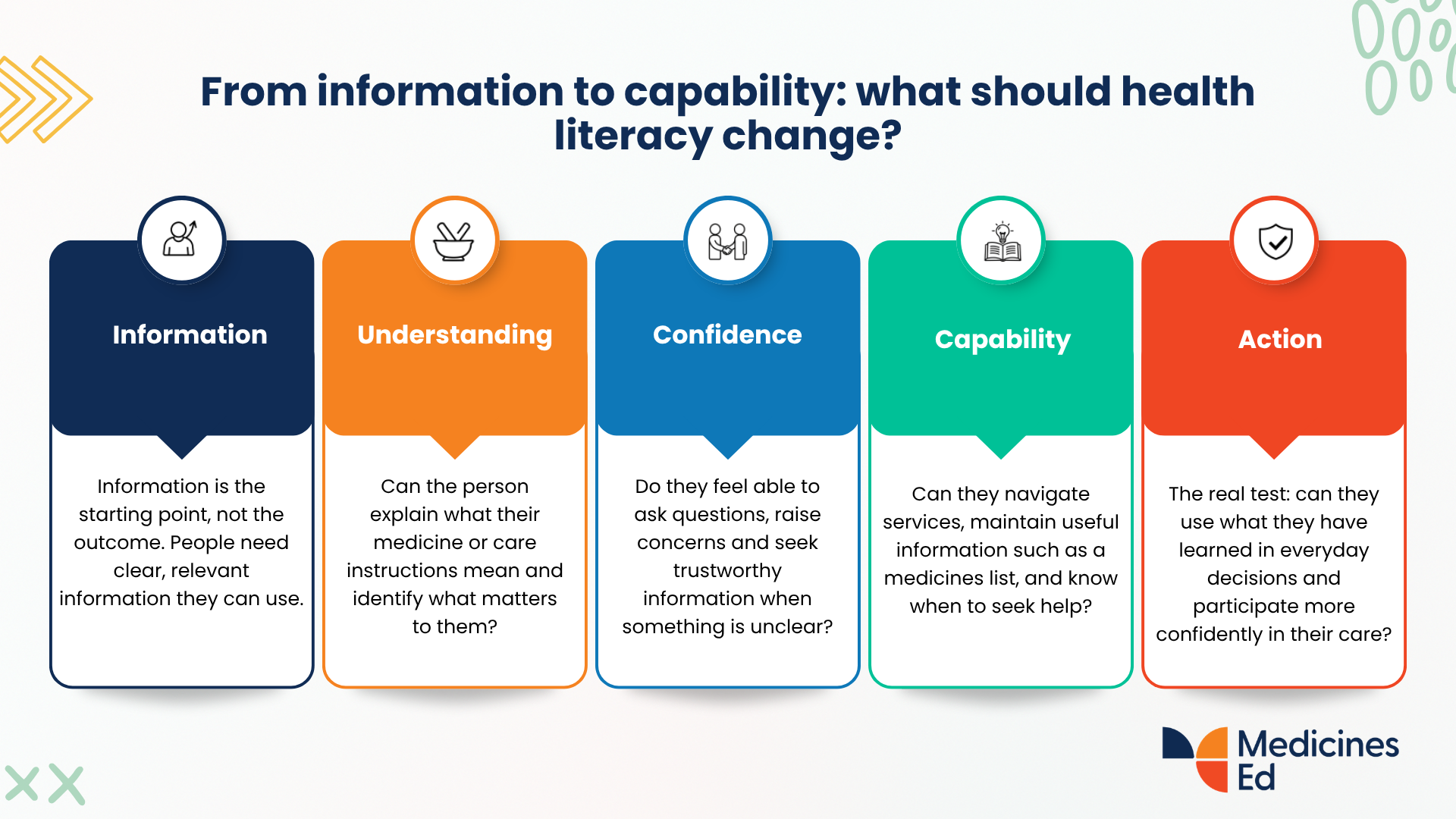
From information to capability: health literacy should help people move beyond receiving information to understanding it, feeling confident, building practical capability and taking action.
Building capability means building the workforce too
Consumer capability is only one side of the equation.
The ability of the workforce to communicate clearly, check understanding and respond to different needs also matters.
Health professionals can have excellent clinical knowledge while still benefiting from practical skills in translating complex information into something a person can understand and use.
The same applies to support workers and others helping people manage medicines and long-term health conditions.
Families and carers are often involved as well. They may help coordinate appointments, keep medicines organised, notice changes and communicate between different parts of the system. Making information and services easier to understand and navigate helps them too.
This becomes particularly important when organisations want effective approaches to continue across communities rather than depend on a single educator or one-off program.
A workshop can build capability among the people in the room.
A workforce equipped to build understanding and confidence can continue doing so long after the workshop has finished.
This is why I think health literacy can usefully be viewed as a form of capability infrastructure: capability within consumers, families and carers; capability within the workforce; and systems that make it easier for people to understand, navigate and participate.
MedicinesEd’s work with Primary Health Networks reflects this broader approach, combining consumer education with workforce capability and models that can support locally delivered, scalable health literacy programs.
A better test of health education
Perhaps the simplest test is this:
Afterwards, is the person better equipped to participate in their own healthcare?
Can they understand more?
Can they ask better questions?
Can they find trustworthy information?
Can they recognise when they need help?
Can they make more informed decisions?
Can they apply what they have learned in everyday life?
And, where family members or carers are involved, are they better equipped to support the person while respecting that person’s role in decisions about their own health?
If the answer is yes, we have achieved something more meaningful than information transfer.
We have begun to build capability.
And if health literacy initiatives are designed around that goal from the beginning, we have a much better chance of creating education that is not simply delivered, but understood and used.
Thinking differently about health literacy?
MedicinesEd works with health organisations and Primary Health Networks to develop practical medicines education and workforce capability programs that build understanding, confidence and the ability to act.
Talk to MedicinesEd about what could work in your community or organisation.
Thinking differently about health literacy?
MedicinesEd works with health organisations and Primary Health Networks to develop practical medicines education and workforce capability programs that build understanding, confidence and the ability to act.
Talk to MedicinesEd about what could work in your community or organisation.
John Woodward is a pharmacist and co-founder of MedicinesEd. He has extensive experience across primary healthcare, medicines education and health-sector governance. MedicinesEd helps people and organisations build the knowledge, understanding, confidence and practical capability needed to use medicines safely and effectively.